What critical equipment should law enforcement prioritise?

James Thorpe
Share this content
If there’s one sector that should serve as a shining example of efficient security operations, it would be local law enforcement, explains Ken Ousey, Regional Sales Manager, Traka Americas.
Perhaps more so than any other organisation, police departments need to have the tools and resources in place to operate effectively and respond to emergencies.
That starts with the physical infrastructure within the police station, which is the backbone of operations and a central hub for all activity.
These facilities represent an intriguing case study of how the proper equipment can empower officers to protect and serve, and, conversely, how not having the right technology can impede their ability to operate.
Keyed in
Police departments are a direct reflection of their community; as cities grow, so too does their law enforcement.
That requires many departments to renovate existing facilities or build new ones that incorporate more modern technology.
Despite this constant evolution, one aspect of operations often gets overlooked, both in existing and new police stations: Key management.
Physical keys are a critical asset that many police departments leverage for access to buildings, cells, holding areas, interview rooms, evidence management and more.
A misplaced key to any one of these areas can be disastrous if it ends up in the wrong person’s hands, yet many departments aren’t installing the necessary protocols to effectively manage them.
They’re still storing keys in a drawer or on a pegboard, which leaves them susceptible to mismanagement and theft.
Station managers may not have clear visibility into who has which key, which can require valuable downtime to identify where a certain key is.
Fortunately, modern technology like intelligent key cabinets exists, which helps law enforcement leadership instil a sense of accountability by having a comprehensive solution to effectively manage all keys.
Managers assign access to certain keys, so only authorised officers can remove sensitive keys like those to an inmate’s cell or to the evidence room.
For smaller departments, all keys are kept in a single cabinet, which helps streamline operations and simplifies the removal/retrieval process.
For larger departments, multiple key cabinets are utilised, which reduces the time spent traveling from one building to another just to remove a key.
Regardless of the size of the department, all transactions are recorded electronically, so that managers see in real time who has which key and can produce an audit report if needed.
If a key isn’t returned on time, managers are notified, which further eliminates downtime spent searching for keys. Cabinets also help eliminate the need to replace keys or even re-key an entire facility if too many have been misplaced.
A unique subset of key management within law enforcement is in fleet management.
Police officers use a variety of vehicles to respond to needs in the community, and often, that means having a key and vehicle ready at a moment’s notice.
Key cabinets are a great catalyst in ensuring that’s a reality, as they clearly show which vehicles are available so that a manager can notify an officer which one he or she can take.
When an officer returns a vehicle, they input into the cabinet interface if there’s something wrong with the vehicle or what the current mileage is.
This helps with servicing vehicles on time, and if there is something wrong with one of them, the system can remove that vehicle key from circulation until the fault has been corrected.
Officers then won’t run the risk of removing a key, only to find out that the vehicle needs an oil change or has a puncture in the tire.
Fleet management is an important example of how key cabinets provide a clear return on investment by extending the life of shared assets – if vehicles are shared evenly and serviced consistently, they don’t have to be replaced as often, which ultimately saves a department money.
However, key cabinets aren’t the only example of critical technology that every police department needs to leverage…
The proof is in the evidence
One of the most glaring aspects of law enforcement operations that too many departments are overlooking is in evidence management.
Countless agencies are storing evidence haphazardly with insufficient reporting systems in place.
Evidence that’s brought back to the station is often kept in a cage or shelf with little to no additional security, beyond a simple lock.
Transactions of its handling aren’t always recorded, which means there isn’t a clear audit trail of who may have come in contact with it.
That can be devastating if that evidence is required in court, as any tampering can render that evidence inadmissible.
Sometimes, that evidence is so small and sensitive that even the slightest improper interaction can cause irreparable harm.
Luckily, just like with intelligent key cabinets, there’s an advanced solution that can solve for these shortfalls. Modern evidence lockers are simple safeguards that police stations can leverage that securely store evidence as soon as it’s brought back in-house.
The locker compartments are accessed only by authorised users and the system instantly records who placed the evidence in each compartment. Managers protect the chain of custody by only granting access to officers who truly need to handle that item.
As is the case with keys, each transaction of handling that evidence is maintained in an audit trail, which can be introduced in court to protect the department’s handling of it.
Modern lockers are also modular, which means departments can categorically store types of evidence in a single locker for faster retrieval and improved processes which, like the cabinets, helps streamline operations.
Additional use cases for intelligent lockers include weapons and asset management.
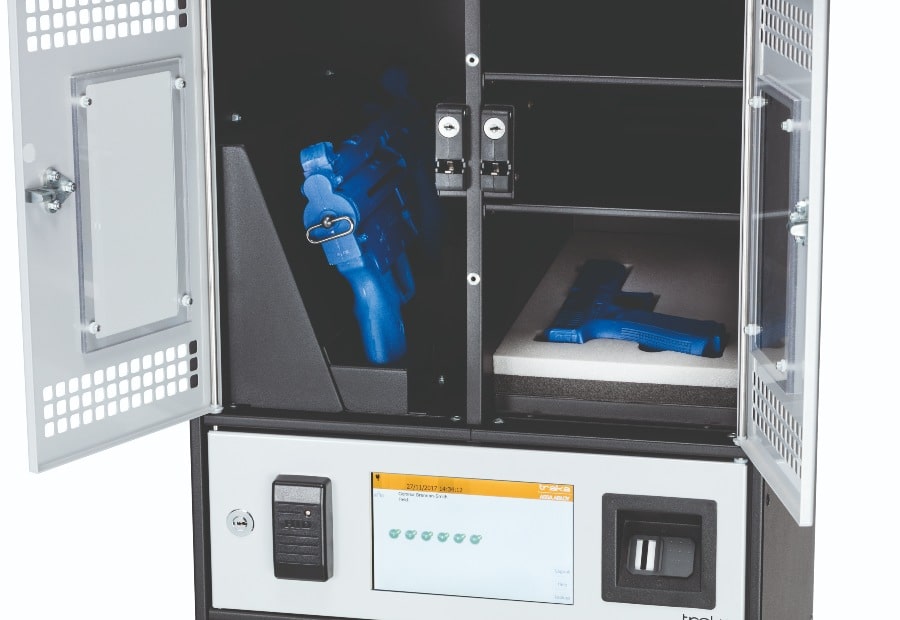
Lockers include handgun and long arm compartments, which can be further protected by multi-factor authentication like badge access, pin code and biometrics to ensure only authorised officers are removing those firearms.
Those compartments also store non-lethal weapons, which can be shared among officers.
Similarly, assets like body-worn cameras, tablets and radios can be stored in modular lockers and charged when not in use.
Lockers prioritise which shared asset has been in the locker the longest, so that when an officer goes to remove one, they are guaranteed to have the most ready-to-use asset within the system.
Just like with the fleet management example mentioned earlier, if there is something wrong with the asset, the officer notes that in the locker interface, which locks that compartment until an administrator repairs it. This helps extend the life of those assets, which improves a station’s bottom line.
The benefits of utilising both key cabinets and modular lockers are multifaceted and extensive.
While it may take time for law enforcement agencies to fully integrate their usage, slowly but surely, this technology will be commonplace in police stations throughout the world, as they undoubtedly provide a clear return on investment and, more importantly – help officers operate at the highest level of efficiency and safely secure the most critical assets that they use daily.